Hewlett-Packard
The Wisdom of CrowdsHewlett-Packard is presented as a company that tested whether an internal market could turn employees’ dispersed knowledge into better sales forecasts. In an experiment lasting three years, small groups of employees traded on expected printer sales; the market’s results outperformed the company’s own forecasts 75 percent of the time. The case illustrates a practical alternative to relying exclusively on hierarchical reporting and managerial judgment.
The printer-sales experiment
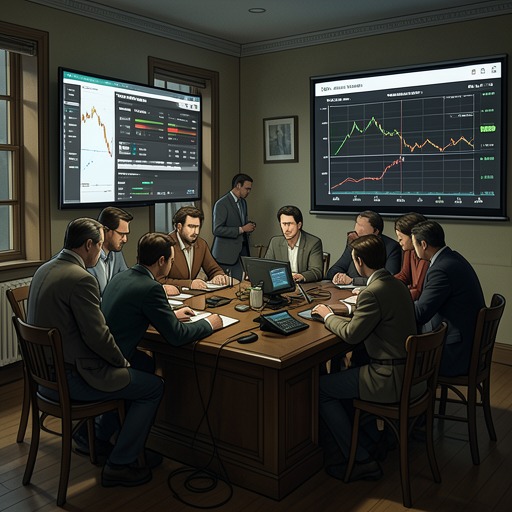
In the late 1990s, Hewlett-Packard experimented with artificial markets designed by economists Charles R. Plott and Kay-Yut Chen. Employees from different parts of the company participated, a choice intended to ensure that the market drew on diverse perspectives rather than a single department’s information. They bought and sold shares according to what they expected printer sales to be in the coming month or quarter.
The markets were modest in scale and duration: between twenty and thirty people took part, and each market ran for only a week. Trading took place during lunch and in the evening. Despite this limited format, the markets were tested over three years, and their results outperformed Hewlett-Packard’s forecasts 75 percent of the time. The account does not specify how the company’s forecasts were produced or give a more detailed measure of the markets’ errors; its reported comparison is the frequency with which the market did better.
Dispersed knowledge and corporate decisions
The experiment belongs to a broader argument about the difficulty of making local knowledge useful across an organization. People close to particular problems often possess experience that cannot easily be summarized or passed up a chain of command. Decentralization can preserve such specialized knowledge and encourage independent judgment, but it also carries a risk: useful information found in one part of a system may never reach the others. Organizations need ways to combine what individuals know without assuming that all decisions must be made at the top.
Hewlett-Packard’s market offered one such mechanism for forecasting. By inviting employees from different parts of the company to trade on their expectations, it converted separate judgments into a shared forecast. The arrangement did not require the participants to become a single deliberative team or wait for a manager to reconcile every view; prices provided a means of aggregating their assessments. Its reported performance made the case for prediction markets concrete: a small, temporary market could outperform the company’s forecast in three out of four comparisons.
Significance and limits
The example is presented as evidence that internal decision markets may help companies forecast the future, even though companies have been hesitant to adopt them. It suggests that organizational charts need not determine the flow of information used in a forecast: employees’ dispersed knowledge can be brought together through a market mechanism instead of being filtered solely through management.
The result is specific to the printer-sales markets described. It establishes neither that markets guarantee good corporate decisions nor that they outperform management in every setting. Its significance lies in the contrast it demonstrates: an organization can test a compact, decentralized method of pooling judgments against its existing forecast, and, in this case, the market did better most of the time.